


Are you looking for the official Mount Kerinci Trail Map? This guide specifically dissects the terrain, elevation, and checkpoints via Kersik Tuo.
Mount Kerinci is a stratovolcano that demands respect. While the mountain can technically be approached from two sides the wilder route via Solok Selatan and the established route via Kersik Tuo this guide focuses exclusively on the latter.
Why Kersik Tuo? Because it is the gold standard. Used by 99% of climbers, the Kersik Tuo route offers the most reliable logistics, clear safety markers, and the highest summit success rate.
Before you study the route below, ensure your logistics are ready:
Arrival: Have you booked your transport? Read our Padang to Kerinci Road Trip Guide.
Rest: Have you secured a bed? Check our Where to Stay in Kersik Tuo recommendations.
If you are set, let’s break down exactly what your legs will face on this standard route.
Here are the vital statistics for the mount kerinci via kersik tuo route:
Starting Point (Pintu Rimba): 1,810 masl
Summit (Indrapura Peak): 3,805 masl
Total Elevation Gain: +/- 2,115 meters
Total Distance: approx. 7 KM (One way)
Average Time: 2 Days 1 Night (Standard) or 3 Days 2 Nights (Relaxed).
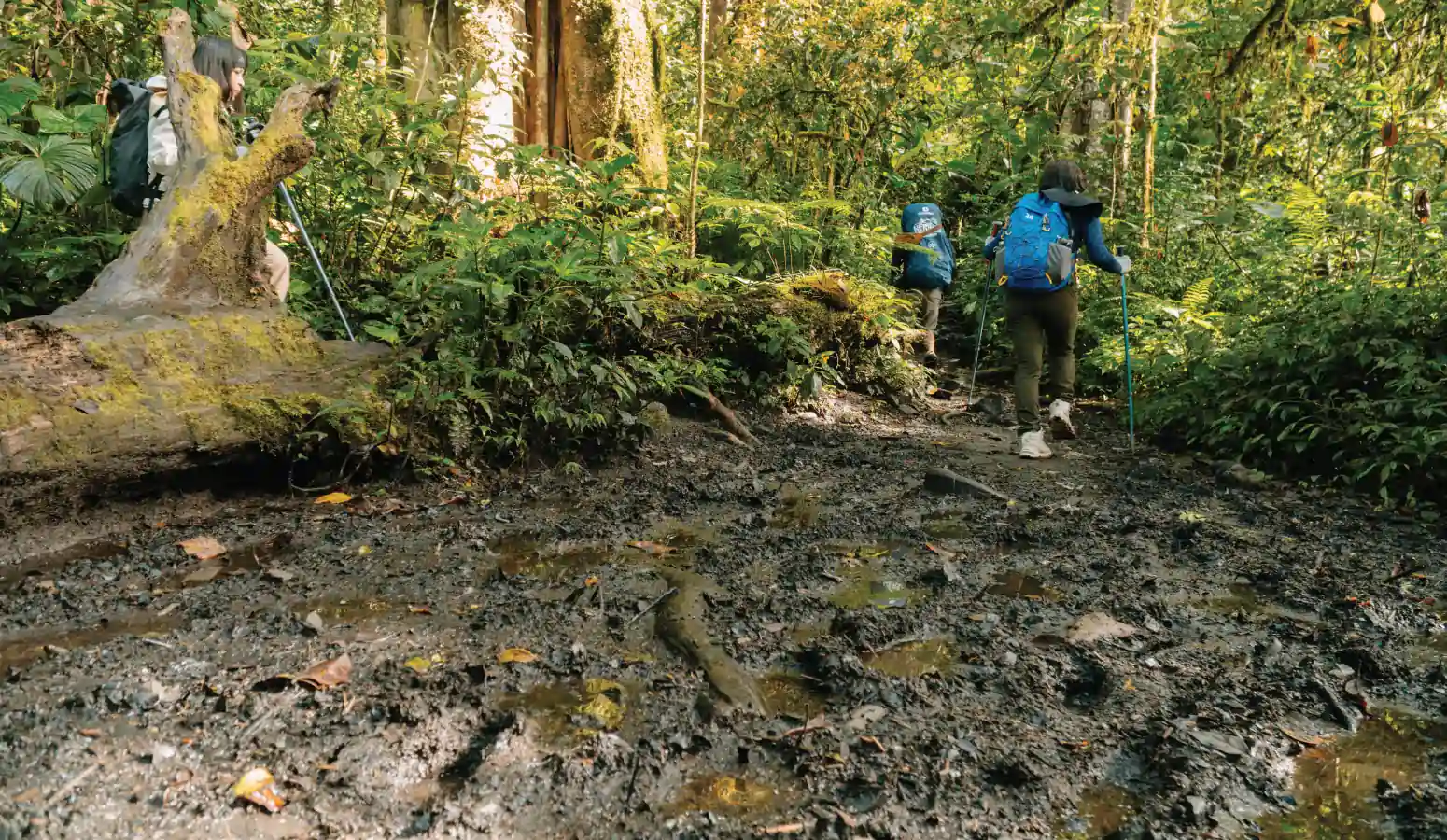
Difficulty: Easy to Moderate
Terrain: Farm land entering tropical rainforest.
Your journey begins at the “Pintu Rimba” (Jungle Gate). The first section heading to Pos 1 (Bangku Panjang) and Pos 2 (Batu Lumut) is relatively gentle. You are walking on compact soil surrounded by dense rainforest.
Water Source: Reliable water is available at Pos 2 (on the left side of the trail). This is where you find your rhythm. The breathing is easy, and the incline is manageable.

Difficulty: Hard
Terrain: Steep Incline, Rainforest changing to Sub-Montane.
This section marks the real physical challenge and a distinct shift in vegetation.
Pos 3 to Shelter 1: You are still moving through the dense Tropical Rainforest. The canopy is thick, keeping the trail humid and shadowed. The incline increases, forcing you to adjust your breathing rhythm.
Shelter 1 to Shelter 2 (The Sub-Montane Zone): The vegetation changes dramatically as you enter the Sub-Montane forest. Trees become shorter and covered in moss. The path transforms into deep gullies (lorong) formed by erosion, requiring high steps over natural root stairs.
Shelter 1 (2,505 masl): A common lunch spot. Solid ground, enclosed by trees.
Shelter 2 (3,056 masl): An alternative campsite. Please note that space is very limited (only fits approx. 5 tents). We usually use this option only for small groups or emergency stops if Shelter 3 is unreachable before dark.
Note: The path from Shelter 1 to 2 is steep and can be slippery if it rains. A small water source is available here (less volume than other posts), but we still recommend managing your main water logistics carefully.

Difficulty: Very Hard but Non-Technical
Terrain: Roots turning into loose volcanic rocks (scree).
Shelter 3 (3,291 masl): This is the highest campsite and the final campsite for the summit push. It is exposed to the wind but offers a stunning sunset view. We usually start the summit push at 03:00 AM or 04:00 AM.
The Summit Push: The vegetation disappears. You enter the “Zone of Grit.” The trail becomes loose rock and sand. It requires endurance, but no technical climbing skills (no ropes needed).
The Reward: Standing at 3,805 MASL, looking into the massive crater, with views stretching to the Indian Ocean and Danau Gunung Tujuh.
You might have heard about climbing mount kerinci via solok selatan. This is a newer, alternate route from the South Solok regency. While it offers a wilder, more pristine jungle experience, the logistics are harder to arrange, and the trail is longer and less established than Kersik Tuo.
For now, Kersik Tuo remains the gold standard for safety and logistical support.
Studying the Mount Kerinci Trail Map is only the first step. Knowing the elevation is one thing; having the lung capacity to conquer it is another.
The rooty terrain of Kerinci punishes those who skip “Leg Day.” To ensure you enjoy the view rather than suffer through it, you need to train specifically for this vertical profile.
What is your next step?
1. For Hikers & Trekkers (Essential): Before you pack your bags, read our complete guide on physical and mental readiness: How to Prepare for Mount Kerinci: Fitness, Gear, & Mindset
2. For Trail Runners & Skyrunners (Advanced): Planning to tackle this route in under 4 hours? We have a dedicated strategy for vertical athletes: Running the Roof of Sumatra: Vertical Skyrunning Strategy


